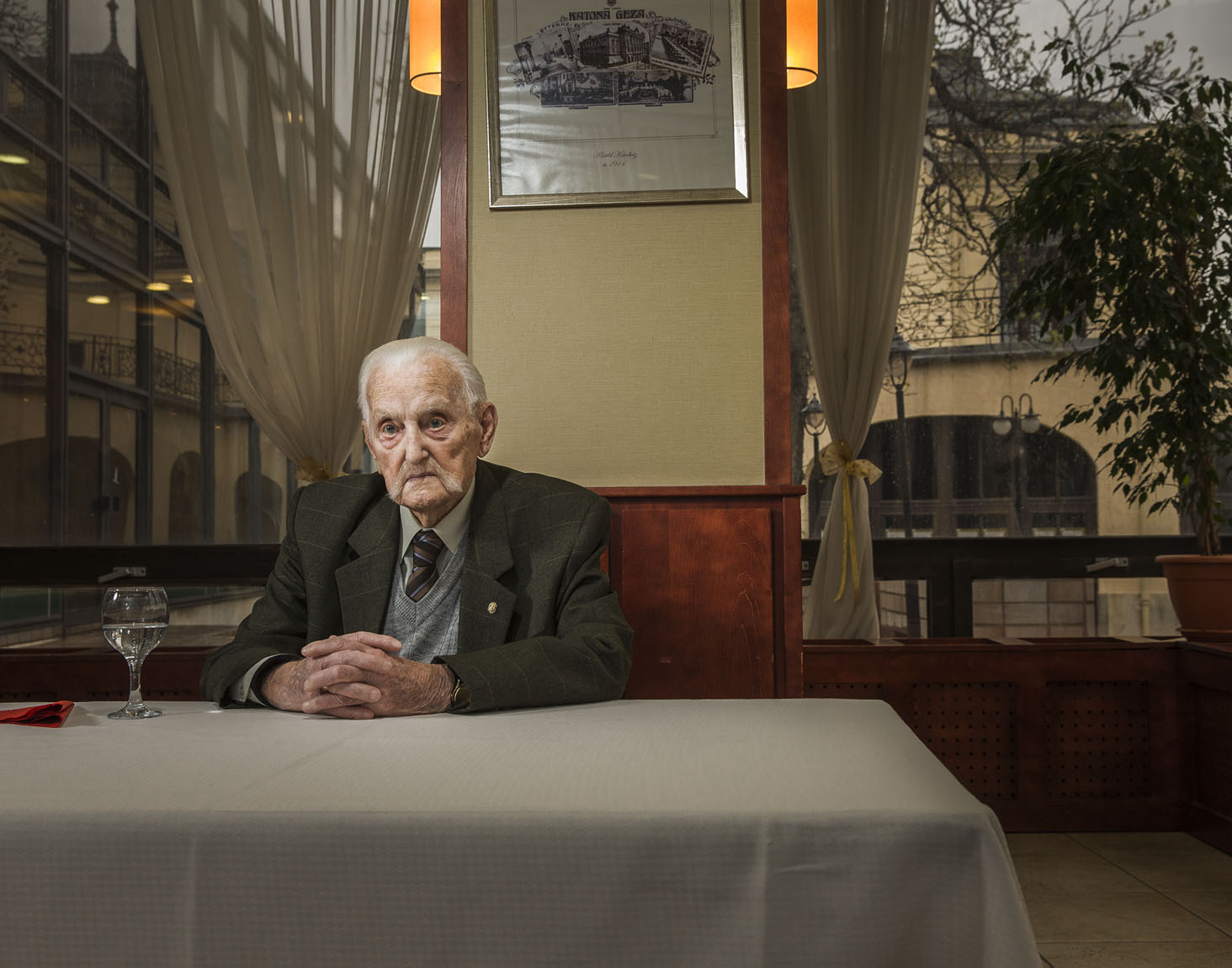
My name is Otto V. Koos, and I was born on December 3, 1915, in Szekesfehervar, Hungary. My father served as a soldier during the First World War, or as we called it back then: The Great War. Who knew at the time that even a greater one was coming in the near future.
At the end of the First World War the country was racked by internal chaos. After a few political decisions, the Hungarian government became committed to the Germans as they awarded us some parts of Transylvania. That explains the close political ties with Germany before the outbreak of World War II.
After finishing the military academy in 1938, I graduated as a second lieutenant. The war was approaching and seemed inevitable. Also, there was still a lot of ethnic and territorial tension within the country that needed to be solved. I continued my service in the army and on October 27, 1941 I received my order to be dispatched to Ukraine.
When I was traveling to the front, I was thinking about the Hungarian Soviet Republic that was formed after the First World War and lasted only for a few months. I was against communism, and therefore I felt patriotic and considered it as my ultimate duty to protect my country, as I didn't want something like that to happen again.
However, when I arrived in Uzhgorod in western Ukraine it became clear that it wasn't the communists I would be fighting with, but it was the Ukrainian Insurgent Army who was fighting against Germany and the Soviet Union at the same time. They had a well-equipped partisan army with modern weapons and we couldn't fight well against them. They were attacking us and at the same time they were also fighting the Russian army. It also became a legal issue, as the partisans were technically civilians, and we weren't allowed to fight or kill civilians. Of course, when bullets are flying no one is going to ask to introduce themselves and show their papers, so we didn't really care. They were our enemies.
During one night in 1941, I was on patrol duty when the partisans opened fire with a machine gun, and I got hit. For a second, it felt like as if someone had punched me on my leg, but then I looked down and knew that I got shot. I was sent back to a hospital in Hungary. The wound was more serious then I expected, so the healing process and then recovery took more than two years.
In 1944, I got engaged to the girl I loved here in Hungary, and then I returned back to the front. I wasn't very lucky this time, either. I got captured by the Russian Army and was taken to Oroshaza with other prisoners. We were a group of 200 captured soldiers, but many died while we were being transported to the camp. I can't remember exactly how many people actually made it. I was treated as some sort of criminal by the Russians and not as a prisoner of war. Eventually I spent 12 years in various camps including the camp in the Oroshaza Mountains and in Vorenzh. Though according to all international laws, I should have been released after the war was over because I never committed any crimes and I was just a soldier serving my country.
Meanwhile, on September 17, 1944, my family house was destroyed by an American air raid because it was located not that far from a military base and they missed the target. The Soviets then captured my mother and grandmother and made them walk to the prison camps located in Germany. My mom and grandma were walking slowly because of their old age, so the Russians shot them dead on the way to the camp. My grandmother was almost 90 years old.
At that time, my sister was married to a guy who used to work at the Mission School in Hungary. The Russian forces were approaching the Hungarian border, so my sister and her husband decided to move the school to Germany. While they were transporting everything to Germany they got captured by the Red Army and killed. That's how my whole family got wiped out by the Russian soldiers during the war.
And I remained in prison camps until the 1950s. Life there wasn't a picnic and I was actually sentenced to 25 years for participating in fighting against the Soviet Army. Ironically, I never really did, for I had been fighting mostly with Ukrainian partisans and a lot of them ended up in the same camps with me.
In the first camp, the prisoners were starved for a long time and a majority of them eventually died. We used to work all day and got very little food. The routine was pretty much similar every day. After a while, the remaining of us got used to starvation. Later in another camp, there was a German teacher, and I felt very hopeful as he started teaching in the camp.
In 1955, the negotiations in Moscow began for the release of Hungarian prisoners, myself included. And finally, on November 21, 1955, I was a free man and traveled back to my home in Hungary. Little did I know, but I when reached Hungary, the local police arrested me and sent me to Jaszbereny along with 270 other prisoners of war. Apparently, our suffering in the Soviet prisons wasn't enough for the communist regime.
Later, I was moved to the Budapest prison and eventually got released on October 8, 1956. I still didn't know that my mother and grandmother had died. I found out soon after my release. All my time in captivity I was looking forward to the moment when I would see my family. And then I found out. Later, I discovered the fate of my sister and her husband as well. The war took everyone and everything I had.
Life went on. I got married on November 17, 1956. We had a son and I started working as a skilled laborer for a company. After a while, I was promoted to a supervisor position and I retired from work in 1980 when I was 65 years old. I have my driving license and I can still drive! I enjoy my life and I talk a lot to youth about the atrocities that war brings.