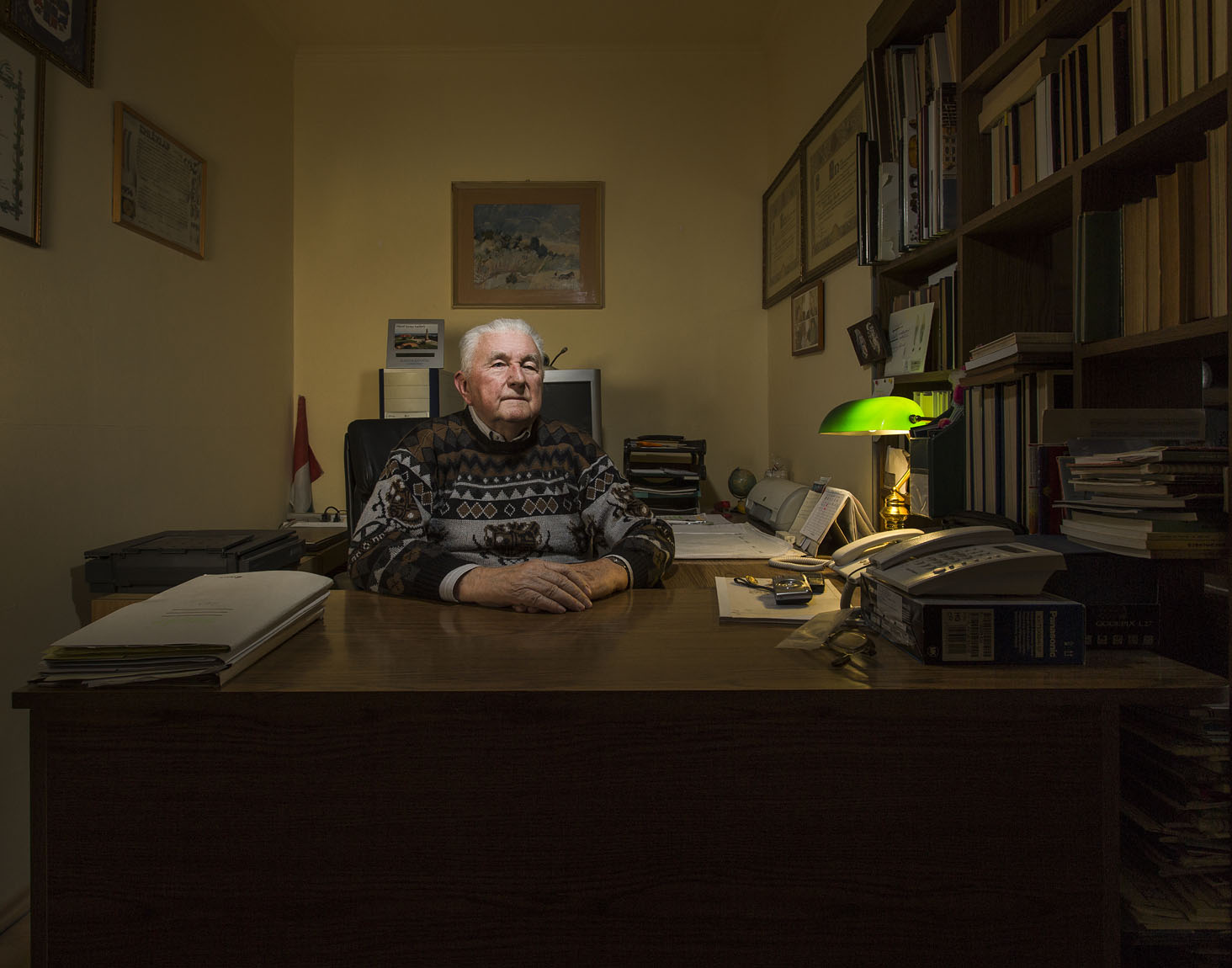
My name is Endre Mordenyi, and I was born on June 10, 1930 in Godollo, a town situated in Pest County, Hungary. I belonged to a traditional military family. My father also served as an army officer and moved to Godollo after the First World War. I believe that I had the innate qualities of a soldier as I have always observed a military environment in my home. When the war began in 1939, I was very young. I applied for the military school in 1940, but I did not get selected because of my poor health. In 1944, I applied again and got admitted to the Gabor Aron Artillery School. The school was located in Romania, but the Soviets invaded the Romanian front in the fall of 1944. Therefore, the Romanian Army capitulated and the school was moved to Sopron, Hungary. Later, when the Hungarian government escaped from Budapest, they moved to the same building where the academy was, so the school was moved again to Sumeg, a town located on the north of Lake Balaton in Hungary.
I attended my first training session for four months in Hungary. During the training period, we did not encounter any fighting, although a little accident happened on the railway lines and a few soldiers were injured. But thank God nobody died! After the training, we went to Bretzenheim in Germany that was a few kilometers away from our training camp. However, on the way there American soldiers captured us and took us to a camp in Tirschenreuth, Germany. At first, I was afraid that I was in the custody of the Soviet Army but quickly realized that it was the Americans. The U.S. forces were just closing and vacating this German town. Initially, there were not many prisoners, but as soon as the war started to end, the U.S. forces brought more and more captives every day. There was not enough space for more prisoners in the camps, so the American soldiers placed us all in a field where we used to spend our whole day on our knees with limited food.
We spent two weeks in that field and there was almost no food, so every morning when we woke up, there were five to eight dead prisoners in the field. We were kept without food one time for four consecutive days. At first, there were American soldiers guarding us, but they soon left and the French Army replaced them. The area was about the size of a European football stadium, and there were 50 such fields next to each other, which were all fenced by the barbed wire. The prisoners were not supposed to cross the three-meter zone near the wire. One night, we were sleeping close to the boundary when we heard the guards shouting and there was a flash of light. We saw a German prisoner trying to escape through the barbed wire, but the French soldiers shot him dead. After that incident, the guards used to fire shots every now and then as a warning sign for the remaining prisoners to stay in their place. We were really very scared of the French guards as the American soldiers were much better trained. I remember once a few prisoners tried to escape but the American guards shot directly at their feet so that they couldn't run. The American soldiers were more capable than the French soldiers and they abstained from killing the prisoners.
After a few months, we were transported to France and while we were walking through a town there with a group of prisoners accompanied by soldiers, the French people started throwing tomatoes and stones at us. There were no fatalities, but a few prisoners got injured. I also got wounded by a stone on my head, but it wasn't too serious. When we got captured I was just a student of the military academy and not a soldier because I wasn't even 18 years old. However, I was wearing the wrong uniform and the symbols on it reflected that I belonged to the group of officers. The officers were separated in this camp from the soldiers, and the supply of food was a little bit better for them as compared to the other camps. And because of this uniform mix-up, I ended up in the camp with the officers.
In July and August, a few human rights organizations stepped up and started a dialogue with the government for the release of prisoners of war. There were all kinds of prisoners including Germans, Russians, Hungarians and Hungarian Germans. The Russians did not want to go back to their country as they were captured by the French soldiers when they were fighting alongside the Germans. Which meant they would be executed or sent to another camp if they went back to the Soviet Union. In the end of October 1945, we were again transported to another camp. While we were travelling in the train, I was sitting near the door of the wagon that was carrying approximately 60 prisoners. Another train crossed us carrying French people, and when that train was passing, the driver threw a big piece of coal towards us that hit my leg and I got injured. Probably, the driver of the other train recognized us as German soldiers and saw our uniforms.
During that time, I was pushed around eight different camps in Germany and France including Tirschenreuth, Kulmbach, Wurtzburg , Bajreuth, Bad-Kreutznach (now Bretzenheim), Voves, Foucarville, Cherbourg and lastly in Mailly de Camp. The Voves camp was near Paris, and it was the central camp for French Foreign Legion recruitment. In this camp, a French officer came to us once and started selecting a few prisoners to organize another foreign legion. He selected six prisoners, including me, to form this legion, and after a while two people from this group were selected to receive a Medal of Honour in France. And two others were selected to come back to Hungary and later participated in the Hungarian Revolution of 1956. I was among those two people.
I came back to Kaposvar, Hungary, where I signed the papers of my release. I returned to our home in Godollo where I found my mother and our house completely destroyed after the bombings. There were no windows or doors left in my home and it was only a structure of bombed-out walls. I came to know that my brother and father also got captured. My mother didn't know anything about them, but she got a letter in 1947 that they are being held somewhere in Russia. My brother was released later that year in July and my father came back to Hungary only in 1951.
I finished my school, and in 1950 I enlisted in the army again. I joined the army as a private and was promoted to a lieutenant after three years. Later, I enrolled myself in the reserve and began my training at the machinery technical school to get a job. In 1956, I got an invitation from the army to rejoin as it was the beginning of the Hungarian Revolution. In a few days I was made the leader of the National Guards of Godollo. There were hundreds of guards, as there were around 35 Russian tanks in the city. On November 4, 1956, I went to the nearby barracks to get some 300 machine guns for the guards. But the officers in the camps disappeared by noon and later by 10 pm all the soldiers capitulated to the Soviets.
However, we got lucky as we didn't kill anyone during the revolution. But we were called several times to the police station for further investigations afterwards. I did not have any alibi, so I was punished and got demoted to the rank of a private again. Having that on my record made it almost impossible to get a job, but I got lucky again as a big factory opened not far from Godollo and they were in desperate need for workers. The factory was manufacturing washing machine motors and there were hundreds of people applying for jobs. I was a technician, so I easily landed a job there, and after just three months I was also awarded as the best employee. I worked in the factory for a few years and later moved to Budapest and got a job in a company that used to manufacture aluminum doors.
In 1968, the same company transferred me to Szekesfehervar where they opened a new manufacturing plant. I stayed here and retired from work in 1979. I was still under surveillance for my active participation in the Hungarian Revolution of 1956. In 1980, I started my own business for manufacturing aluminum windows and doors. I stayed in this business until the year 2000. I was working from dawn till night. I also had two kids, but they couldn't be a part of this family business because of a funny story. Well, funny in a way.
In 2000, I had a heart attack and I was admitted to the hospital. But I escaped the very next day and sold my business that very same day as my cardiac arrest was caused by a lot of stress. From then onwards, I believe I have a healthy heart condition. Now I am helping veterans and their families in Szekesfehervar County, with the help of my wife. I am working as the editor of a website and we are working with several partner organizations including the HOHE center of Budapest, Armed Forces and Society Circle of Friends Szekesfehervar Organization, Wathay Fraternal Association and a few others. We conduct regular general meetings of the county's membership organizations to improve our service toward veterans and their families.